
Time:2026-03-12 Browse: 1
A complete TFT-LCD display module primarily consists of: a TFT-LCD display panel and its driving circuit system, as well as a backlight unit (BLU) and its driving circuit system.
If it is a fully laminated TFT-LCD display module, it also includes: cover glass (CG), capacitive touch panel (CTP), and optically clear adhesive (OCA), etc. In the entire manufacturing process of the LCD module, after the large mother glass has been cut but before the polarizer is attached and the bonding of driver ICs, FPCAs/PCBAs, and other driving circuit components is completed, this state is generally referred to as a "single Cell" in the industry. If the polarizer has been attached and the bonding of driver ICs, FPCAs/PCBAs, and other driving circuit components is complete, it is generally called an Open Cell (OC for short). Some manufacturers broadly refer to this as FOG.
A complete Open Cell's driving circuit will include: Gate Driver IC, Source Driver IC, printed circuit board (PCBA) connected to the source driver circuit, timing controller PCBA (T-CON board for short), flexible printed circuit (FPC) connecting the PCBA and the T-CON board, etc.
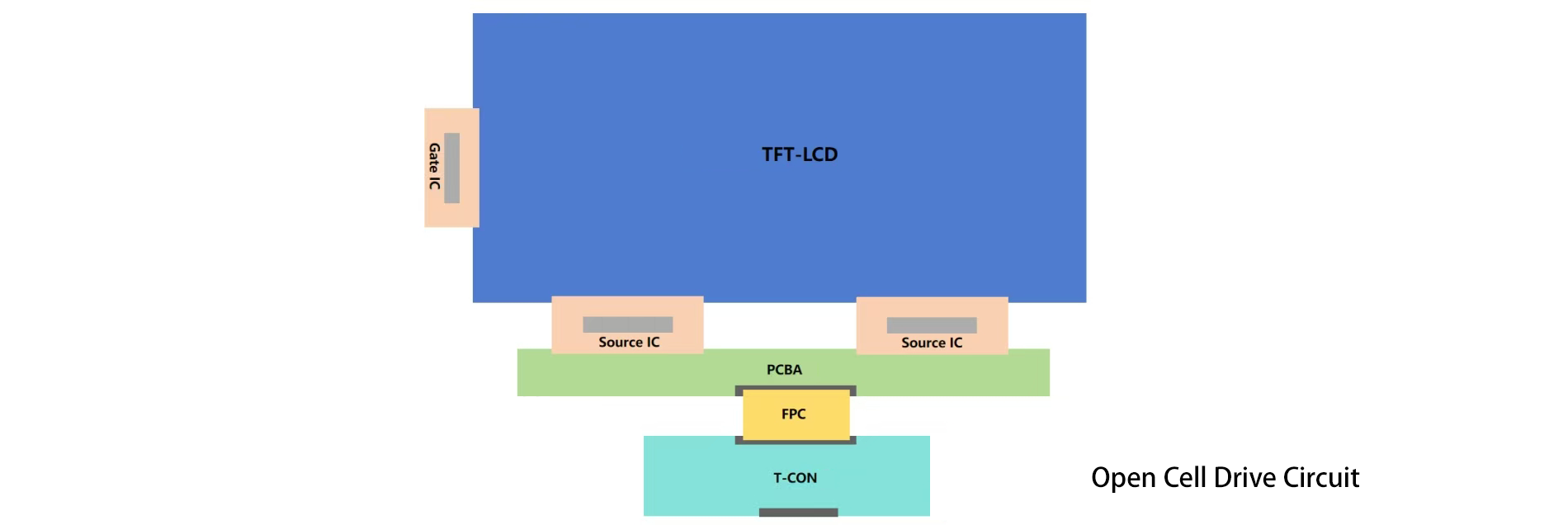
The aforementioned Open Cell driving circuit system is relatively traditional. Currently, in medium and small-size products, the mainstream approach is to use Gate on Array (GOA) to replace the Gate IC, while the PCBA board and the T-CON board are also integrated into a single unit.
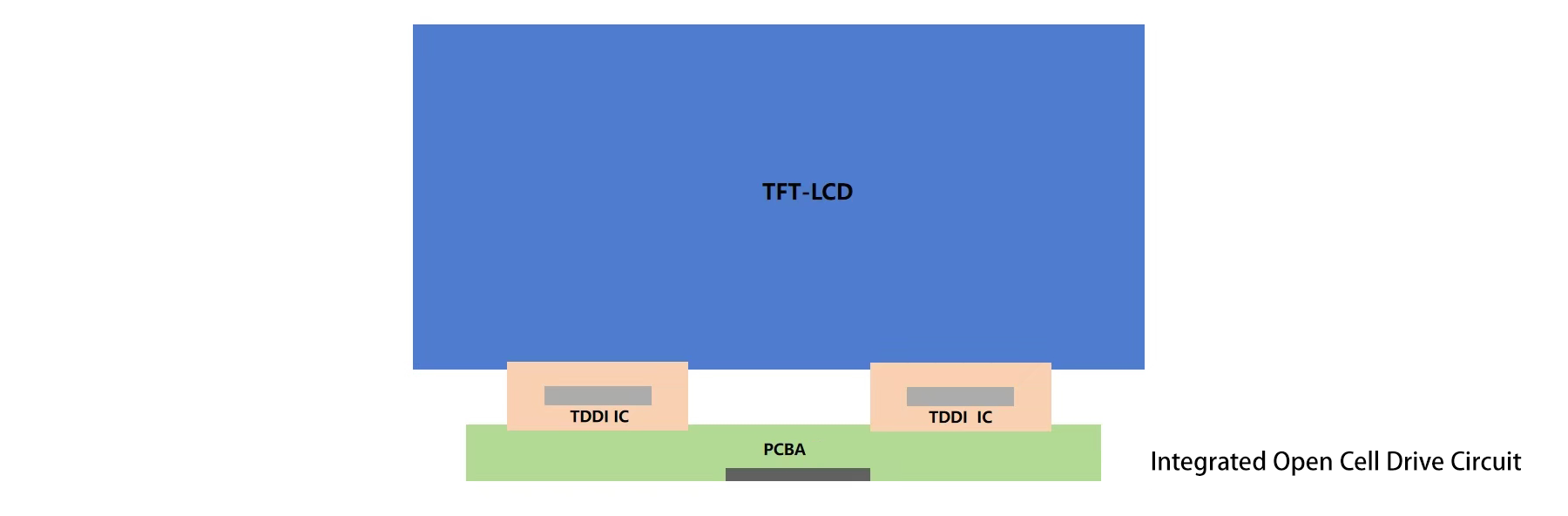
The driving process of the Open Cell circuit works as follows: The external power supply enters the driver IC via the FPCA and PCBA. Through the internal circuits of the driver IC or in conjunction with external circuits, various voltages are generated and output. These combined output voltages serve two purposes: On one hand, they provide power to the IC's own driving circuit to ensure its normal operation; on the other hand, after adjustment, they supply power to the LCD panel to ensure normal display. Therefore, these driving voltages are crucial as they directly affect the display quality and stability of the LCD.
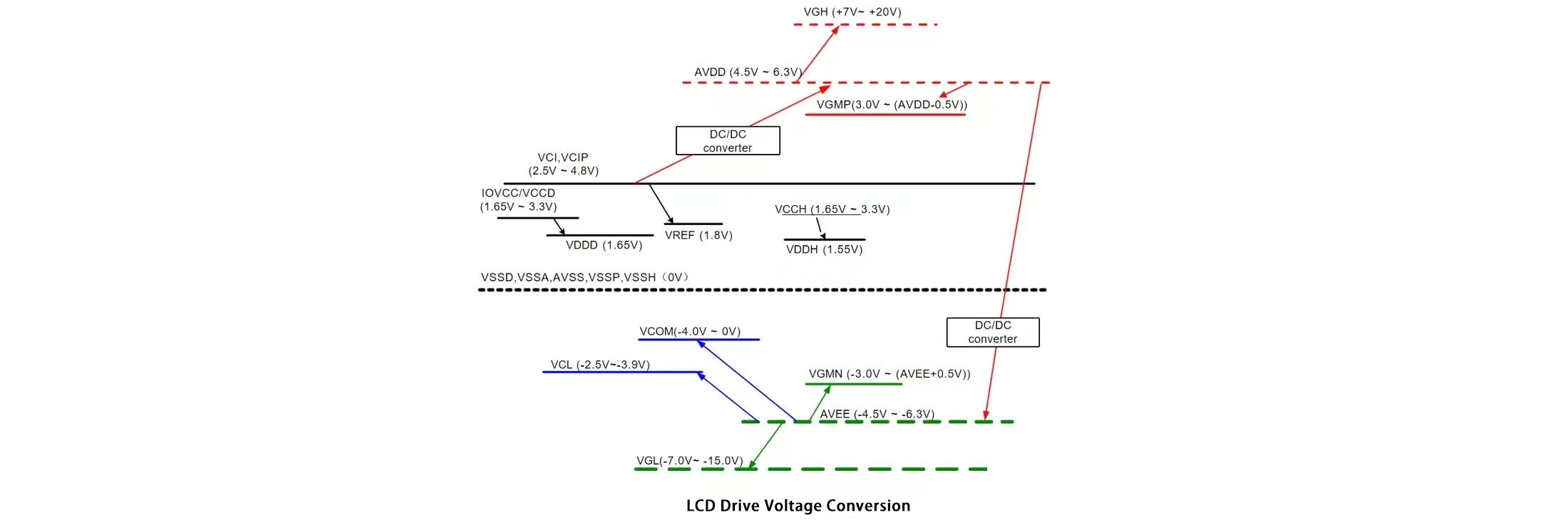
This article primarily shares insights on the "Functions of Common Driving Voltages in TFT-LCD Display Modules."
1.VDDI: Also known as IOVCC or VCC, this is the I/O supply voltage, sometimes referred to as the logic voltage. It is supplied to the driver IC from a test fixture or mainboard and powers the input/output interface circuits. The typical voltage range for VDDI is 1.65V to 3.6V. Currently, 1.8V is the standard VDDI voltage used in mobile phones and tablet products.
2.VSP: Also known as AVDD, this is the positive power supply voltage provided by the mainboard or tester. It serves as the core power supply for the source driver and directly affects the voltage accuracy of the LCD pixel electrodes and the quality of the displayed image. The typical voltage range for VSP is 4.5V to 6.5V; please refer to the specific datasheet for details.
3.VSN: Also known as AVEE, this is the negative voltage supplied by the mainboard or test fixture. Together with VSP, they form a positive-negative pair and serve as the core power supplies for the source driver (Source Driver), directly affecting the voltage accuracy of the LCD pixel electrodes and the quality of the displayed image. The typical voltage range for VSN is -4.5V to -6.5V; please refer to the specific datasheet for details.
In medium and small-size products, the typical voltage value for VSP is usually 5.5V, while that for VSN is typically -5.5V. VSP and VSN charge the capacitors controlling the pixels to ultimately enable the LCD display function. If the VSP or VSN voltages are abnormal, the LCD display generally exhibits defects such as flickering, no display, or high current consumption.
4.Vcom: This is the common electrode voltage for the liquid crystal, serving as the reference voltage for LCD driving. The Vcom voltage affects the overall display performance of the LCD, such as causing afterimages, color distortion, whitening, or flicker. The specific value of the Vcom voltage depends on the LCD itself; please refer to the specific datasheet for details.
5.VGH: Also known as VGHO, this is the positive voltage used to turn on the TFT Gate electrode. When a specific row of the LCD display is being scanned, the VGH voltage is applied to the Gate line of that row, turning on all TFTs in the row and allowing the data voltage from the Source lines to charge the pixel capacitors. The typical voltage range for VGH is 7V to 20V; please refer to the specific datasheet for details.
6.VGL: Also known as VGLO, this is the negative voltage used to turn off the TFT Gate electrode. After the LCD display scanning is completed, the voltage on the Gate line returns to VGL, ensuring that the TFTs are completely turned off and allowing the pixel capacitors to maintain a stable charge until the next frame refresh. The typical voltage range for VGL is -15V to -7V; please refer to the specific datasheet for details.
Since VGH and VGL are the voltages that control the opening and closing of the LCD Gate electrode, if the VGH or VGL voltages become abnormal, the LCD display generally exhibits defects such as no display, overall whitening, afterimages, horizontal lines, or a scrambled screen.
7.VSS: Also known as VSSA, VSSREF, VSSD, VSSP, or VSSH, this can be simply understood as the ground voltage. It serves as the reference ground potential, typically 0V.
8.GVDDP: Also known as GVMP, this voltage may have different names depending on the IC specifications. It represents the positive Gamma voltage for the LCD display, typically ranging from 3.0V to 6.0V. When adjusting this Gamma voltage, it is generally fine-tuned in steps of 10mV or 20mV; however, the specific step size defined in different IC datasheets may vary.
9.GVDDN: Also known as GVMN, this represents the negative Gamma voltage for the LCD display, typically ranging from -3.0V to -6.0V. When adjusting this Gamma voltage, it is generally fine-tuned in steps of 10mV or 20mV.
10.Four Input Voltage Modes for Driver ICs:
①2-Power Mode: VDDI + VCI. This mode requires an external boost IC (Power IC) to generate the VSP and VSN voltages. Currently, products utilizing the 2-Power mode are relatively rare, making it a non-mainstream solution.
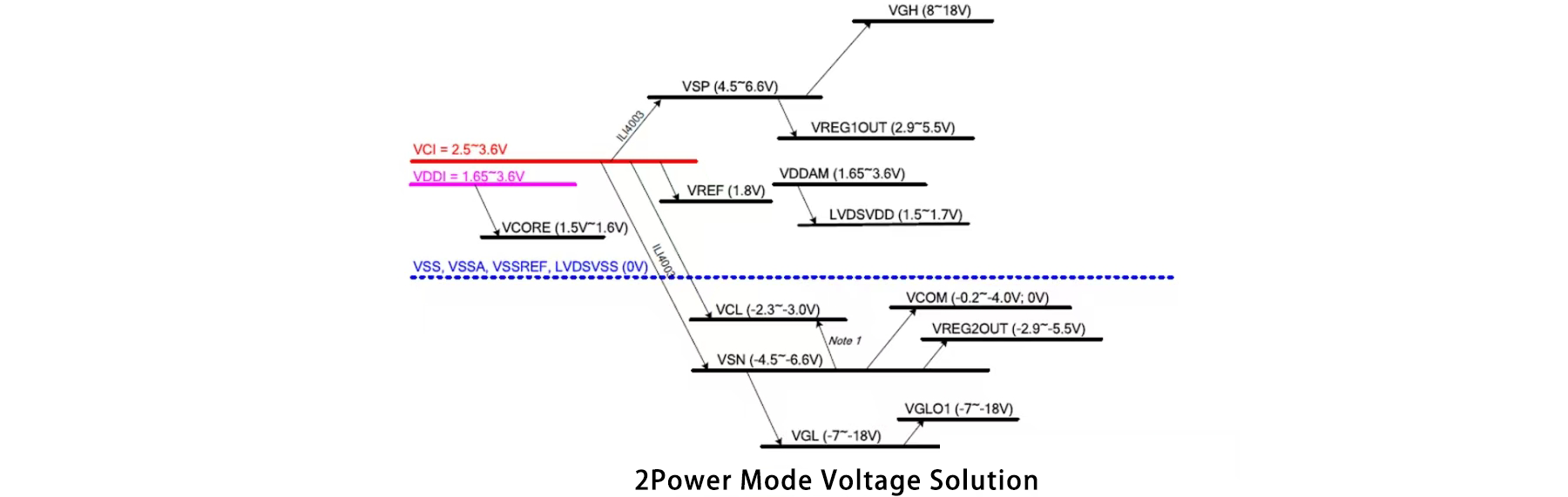
②3-Power Mode: VDDI + VSP + VSN. This mode does not require an additional external boost IC, as the driver IC can generate the necessary voltages internally. The 3-Power mode is currently the mainstream solution.
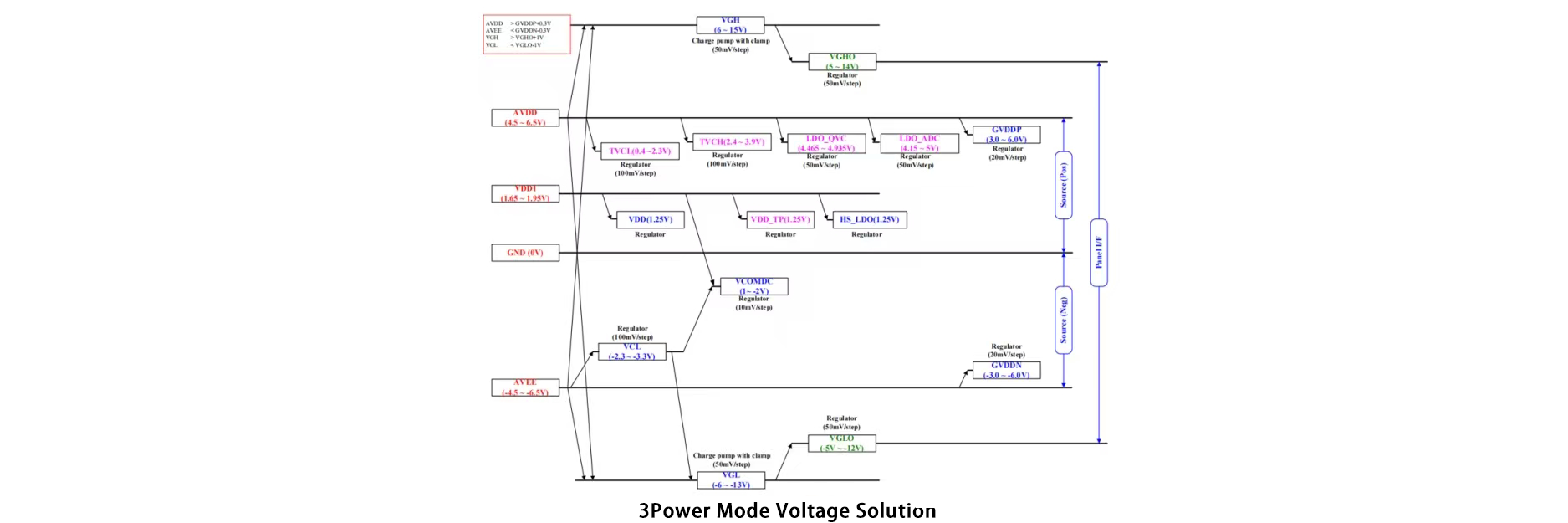
③4-Power Mode: VDDI + VSP + VSN + VDD. This mode does not require an additional external boost IC, as the driver IC can generate the necessary voltages internally. Currently, most driver ICs are compatible with both 3-Power and 4-Power modes.
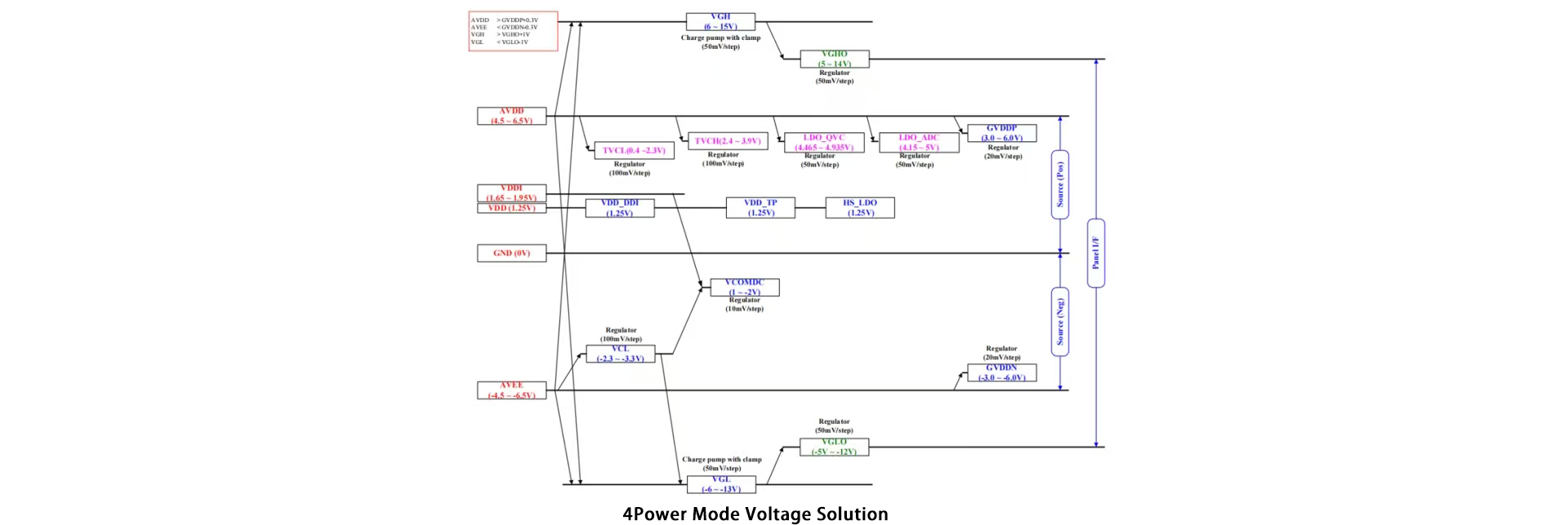
④5-Power Mode: This includes five voltages—VDD, AVDD, VSP, VSN, and Vcom. No additional external boost IC is required, as the driver IC can internally generate the necessary voltages.