Luminance is one of the most critical performance indicators for LCD modules after full lamination. The accuracy of evaluating luminance directly affects the module's specification compliance, product yield, and material selection costs.
The industry primarily adopts the "Reference Comparison Method" to evaluate luminance. This involves comparing a "Benchmark Module" (from mass-produced units) against an "Evaluation Module" (the unit under test), and conducting a factor-by-factor comparison of the variables affecting luminance between the two.
When using the "Reference Comparison Method" for evaluation, it is generally recommended that key parameters—such as display module size, thickness, color gamut, and the target customer—be as similar as possible between the evaluation group and the control group. This ensures a more accurate assessment of luminance.
In LCD optical-bonding display modules, numerous factors affect luminance, such as LCD panel transmittance, backlight brightness, touch panel structure, lamination method, polarizer type and transmittance, as well as OTP programming content.
I will primarily analyze the impact of full lamination on display module luminance, focusing on the following four aspects: touch panel structure, lamination method, polarizer type and transmittance, and OTP programming content.
1. Touch Panel Structure — CG/TP
The touch panel structure of LCD display modules is primarily divided into two types:
●Built-in structures (In-Cell or On-Cell), where the touch type is determined during the module manufacturer's shipment and cannot be altered;
●External structures, which consist of a separate Touch Panel (CTP) and Cover Glass (CG) that can be customized according to customer requirements. Industrial products primarily adopt external structures.
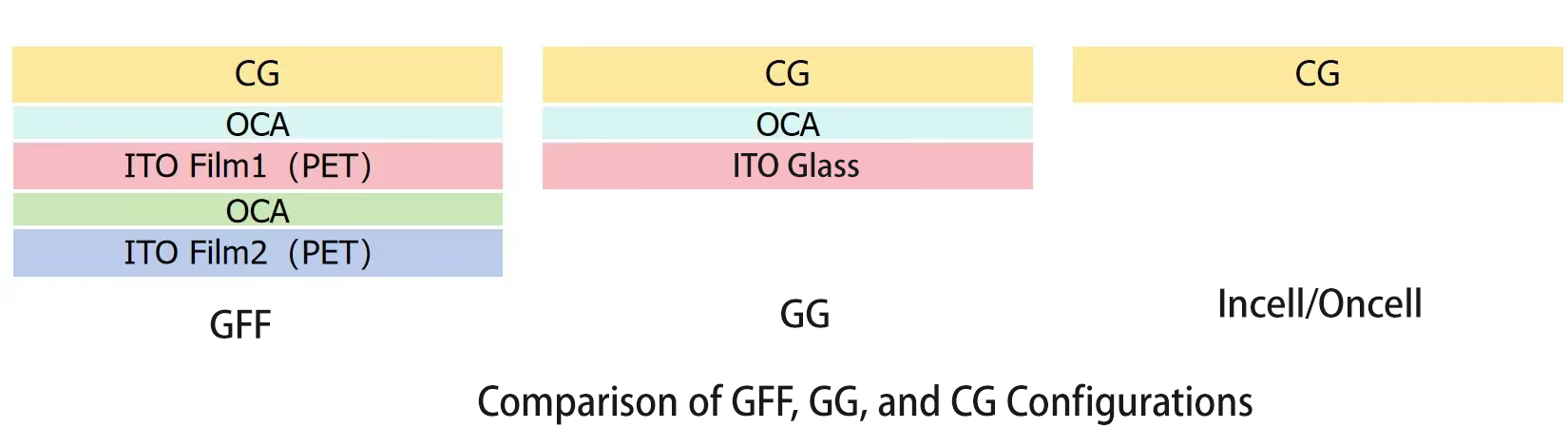
Regarding CTP structures, they can be further classified into GFF and GG structures based on the number of touch sensor layers.
For full-lamination products:
●Built-in structures are typically paired with a Cover Glass (CG);
●External structures generally integrate the LCD module with a Capacitive Touch Screen using either GFF or GG structures.
When evaluating the luminance of full-lamination LCD modules, the impact on brightness varies depending on whether the Cover Glass (CG) or the Touch Panel (CTP) is laminated to the LCD using Optical Clear Adhesive (OCA).
- ①When laminating a Cover Glass (CG) to the LCD using OCA, the transmittance of the CG unit is typically evaluated
- at 98%.
- ②When using external touch panel structures such as GFF or GG, the transmittance of the Capacitive Touch Screen
- unit is generally evaluated at 96%.
2. Lamination Methods — Frame Bonding/Optical Bonding
The lamination methods for LCD display modules are primarily divided into two types: Frame Lamination and Full Lamination.
●Frame Bonding: This method uses a frame-shaped foam adhesive to bond the Capacitive Touch Panel (CTP) and the LCD module.
●Optical Bonding: This method utilizes OCA (Optically Clear Adhesive) solid optical glue or OCR (Optically Clear Resin) liquid optical glue to bond the Capacitive Touch Screen, Cover Glass, and LCD. In small-to-medium sized full-lamination applications, OCA solid optical glue is predominantly used. Within the industrial sector, high-end products often employ OCR liquid optical lamination to ensure product reliability.
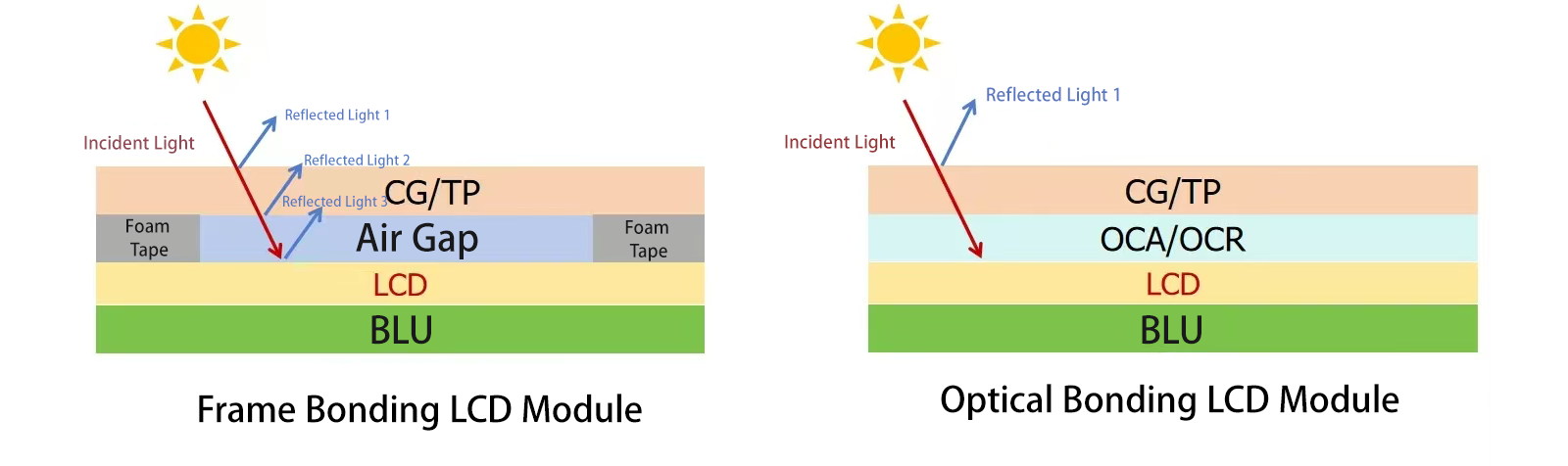
In traditional frame bonding structures, light undergoes refraction and reflection across two interfaces: "Cover Glass/Touch Panel (CG/TP) to Air" and "Air to Cover Glass/Touch Panel (CG/TP)". Due to the significant difference in refractive indices—approximately 1.52 for the cover glass and 1.0 for the air layer—the interfacial light reflection and associated losses are substantial.
Conversely, in optical bonding structures, the refractive index of the OCA (Optically Clear Adhesive), approximately 1.48, closely matches those of the cover glass (~1.52) and other layered materials such as the polarizer's PVA, TAC, and PSA, which range from 1.48 to 1.53. This optical consistency allows light to transmit seamlessly between materials. Consequently, the only significant reflection occurs at the outermost surface of the cover glass where it meets the air. As a result, light reflection and optical losses are typically minimal.
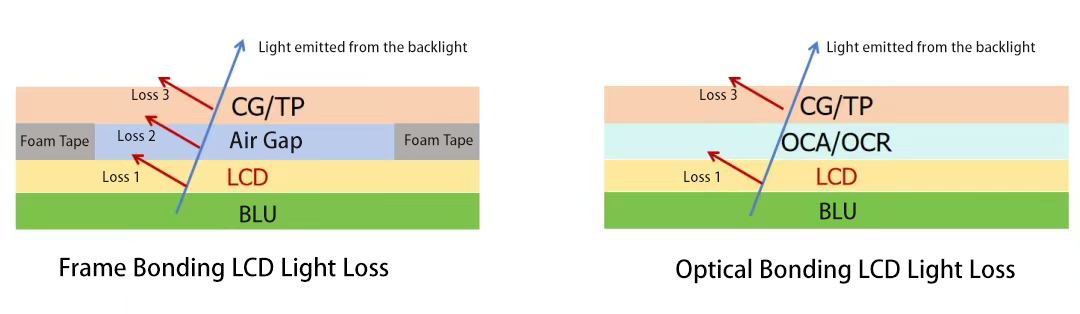
According to the physics of optical loss, when light passes through two transparent media with different refractive indices, reflection inevitably occurs at the interface. The greater the difference in refractive indices, the higher the amount of reflected light.
Consequently, in a powered-off state, frame-bonding LCDs exhibit a significant sense of layering between the CG/TP and the LCD. The display appears whitish overall, resulting in relatively poor image quality and lower brightness.
Industry-wide, frame-bonding TP structures incur approximately 4–6% more brightness loss compared to optical-bonding TP structures. In other words, if a optical-bonding TP solution is adopted, the display module's brightness is evaluated at 96%; however, if a frame-bonding TP solution is used, the display module's brightness must be evaluated at 90–92%.
3. Polarizer Type and Transmittance
Polarizers are primarily categorized into two types: standard polarizers and reflective polarizers (also known as Advanced Polarizer Film, or APF).
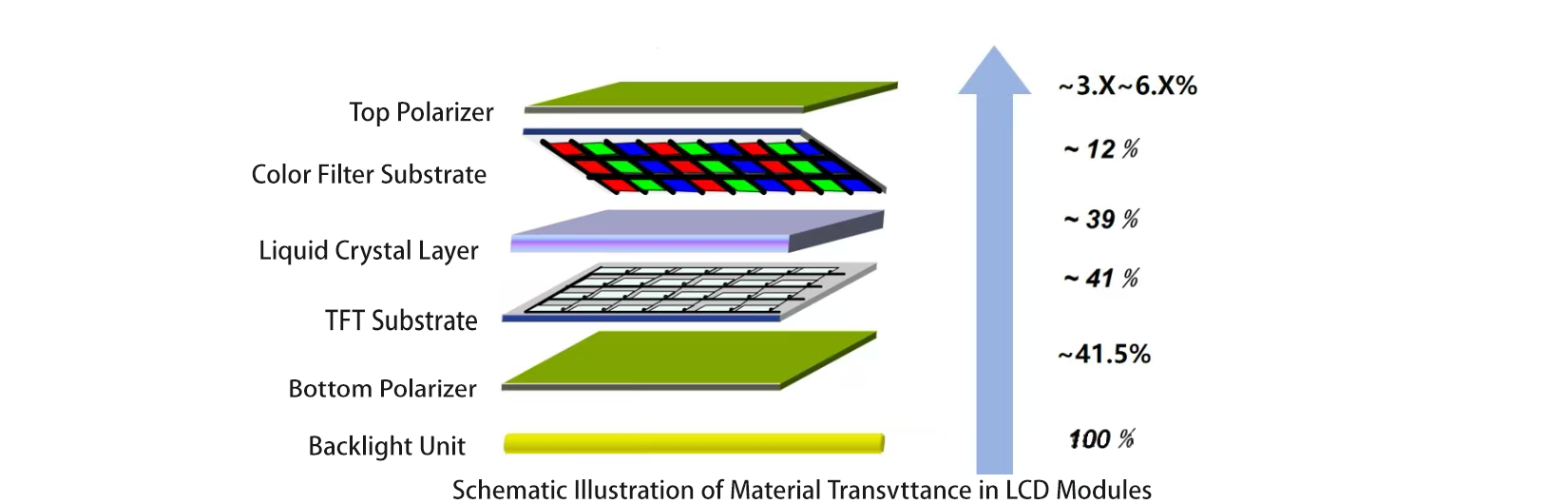
The transmittance of a standard polarizer unit is typically around 41.5%. However, driven by increasing customer demands for higher LCD brightness, High-Transmittance Polarizers have been developed.
High-Transmittance Polarizers: These are engineered by adjusting the draw ratio during PVA (Polyvinyl Alcohol) dyeing and modifying the solution concentration within the dyeing tank. This optimization process increases the polarizer unit's transmittance from 41.5% to a range of 42.5%–43%, representing an improvement of approximately 2.5%–3.5%.
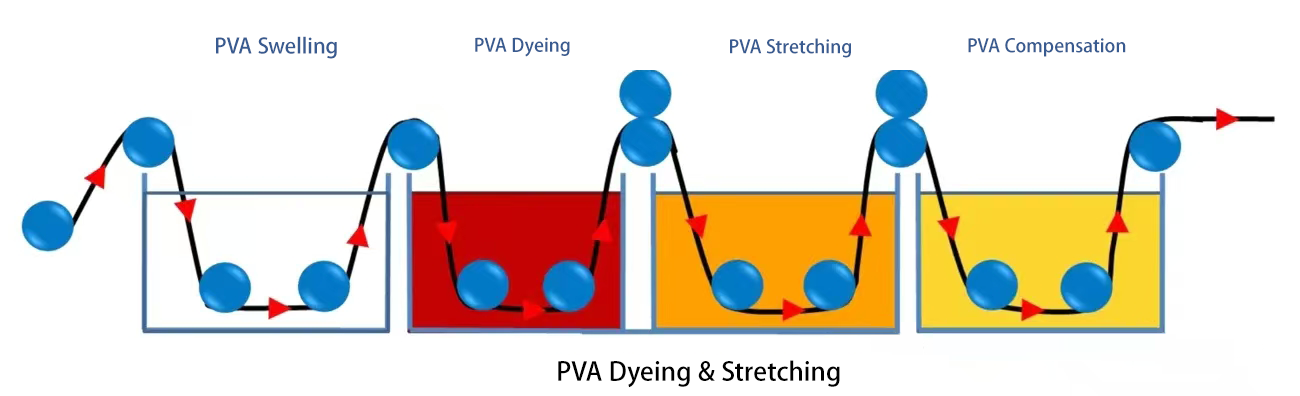
After enhancing the overall transmittance of the polarizer's PVA layer through the dyeing process, careful attention must be paid to changes in key parameters such as single-unit transmittance, parallel transmittance, crossed transmittance, and polarization degree.
Furthermore, the display performance of the LCD under black screen conditions is critical after subjecting the high-transmittance polarizer to reliability tests—such as high/low temperature and high-temperature high-humidity testing. Defects such as a "whitish" or "bluish" tint appearing under the black screen may potentially occur.
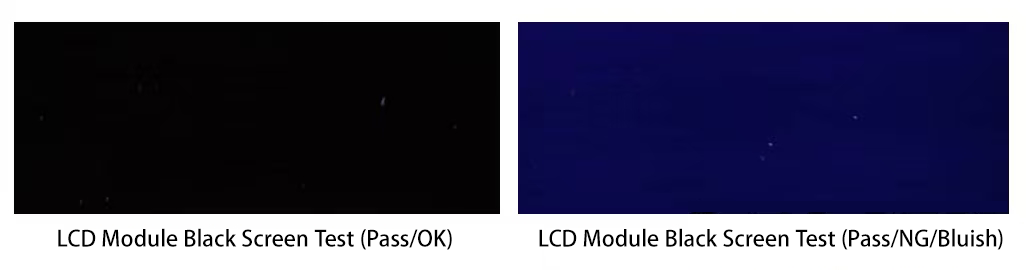
In addition to the aforementioned high-transmittance polarizers, if the customer has high brightness requirements for the LCD and the backlight unit (BLU) alone cannot meet them, an Advanced Polarizer Film (APF) can be utilized.
The luminance gain factor of an APF typically ranges from 1.35x to 1.45x. Assuming a 1.4x gain factor for evaluation, if the customer has stringent requirements regarding the subjective display quality (e.g., Newton's rings), selecting a diffusive adhesive-type APF (with haze) will result in a reduction of approximately 3% in the display module's brightness.
4. OTP Programming Content
OTP refers to "One-Time Programmable" code. To optimize the LCD display performance and enhance image quality, OTP programming is typically performed on LCD modules. The primary data programmed includes: Vcom adjustment, module display driver parameters, ID codes, and Gamma correction.
Among these, Gamma programming is the key factor affecting the brightness of the full-lamination display module.
Gamma programming is categorized into 3Gamma (White Balance) and 1Gamma. Furthermore, 3Gamma is subdivided into Dynamic 3Gamma and Fixed 3Gamma. Both Dynamic and Fixed 3Gamma are the main factors influencing the brightness of the full-lamination display module.
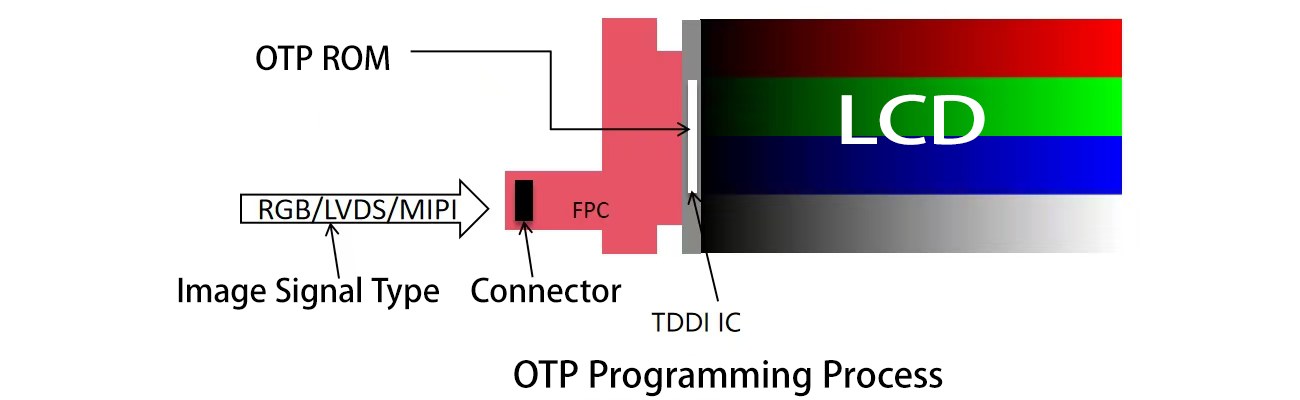
3Gamma: This refers to programming one set of Gamma curves for each of the RGB channels. By adjusting the voltage levels for the RGB images, the brightness of each channel is altered, thereby shifting the white point coordinates. However, this process typically results in a corresponding loss of module brightness.
For full-lamination display modules:
●If Dynamic 3Gamma is programmed via OTP, the brightness loss is approximately 10%.
●If Fixed 3Gamma is programmed, the brightness loss ranges from 5% to 6%.
If the customer has strict requirements for white point consistency, necessitating the use of 3Gamma programming to adjust the coordinates, this associated brightness loss must be factored into the initial brightness evaluation. This consideration is crucial to avoid potential issues where the LCD module fails to meet the required brightness specifications.
Finally, I would like to share some insights regarding the selection between frame lamination and full lamination for the market:
●For products intended for harsh environments with high display quality and high reliability requirements, OCR full lamination is recommended.
●For products with strict cost constraints and lower reliability demands, frame lamination or OCA full lamination are suitable choices.