Both FPCs and LCDs are highly "precision" components. The connection and electrical continuity between FPC bonding fingers and LCD bonding pads are achieved through ACF (Anisotropic Conductive Film) under specific conditions of heat, pressure, and time.
During the FOG (FPC on Glass) bonding process, high precision and tight tolerances regarding the dimensions of bonding equipment and materials are required. However, during the high-temperature lamination process, thermal expansion of materials is inevitable, which can lead to FOG bonding misalignment defects.
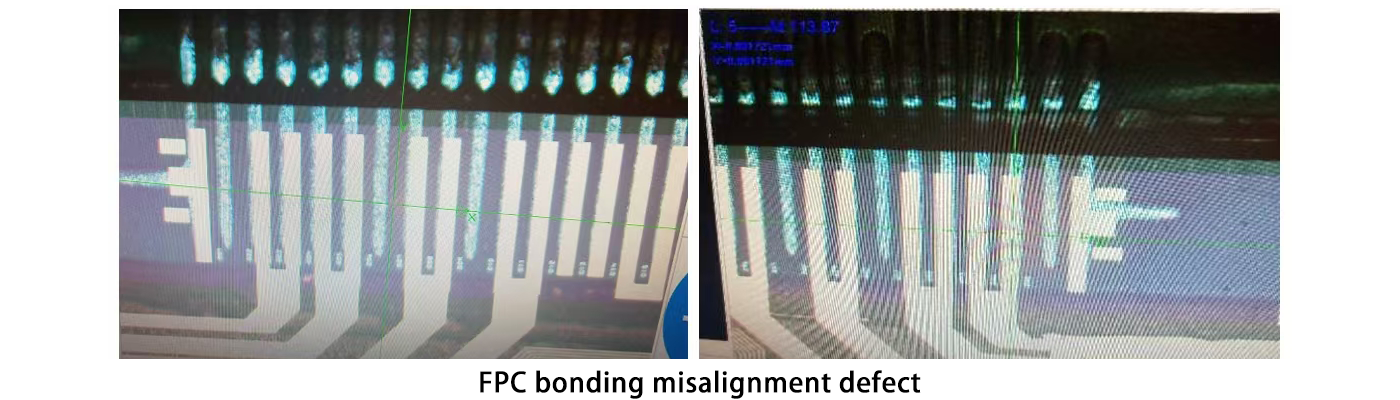
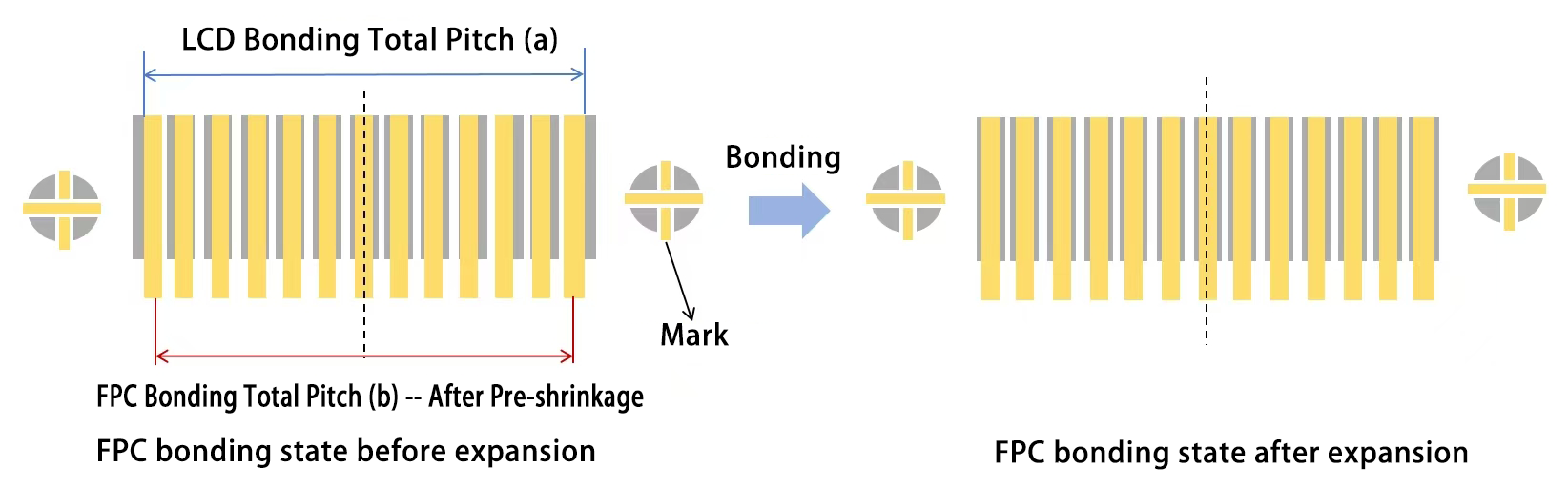
Based on this, to avoid a series of problems caused by FOG bonding misalignment due to excessive expansion of the PC base material, the mainstream industry practice is to implement a "pre-shrinking design" for the finger pitch of the FPC bonding gold fingers.
This means: The pitch dimension of the FPC bonding fingers is designed to be slightly smaller before high-temperature bonding, so that after thermal expansion during high-temperature lamination, it can match perfectly with the LCD pads.
For the pre-shrinking design of FPC gold fingers with small-size FOG bonding structures, the following is generally recommended:
①The pitch of the FPC bonding gold fingers should be pre-shrunk by 10‱ (ten parts per ten thousand). This means the FPC manufacturer is required to reduce the pitch dimension by 10‱ during fabrication.②Only the total pitch of the FPC bonding gold fingers requires pre-shrinking. The two outermost alignment marks must be designed at a 1:1 scale and should not be pre-shrunk.
③To ensure the stability of the bonding process and reduce minor misalignment defects, it is generally recommended to control the CPK of the FPC bonding finger pitch, with a requirement of CPK > 1.0.
For different bonding structures such as COG, COF, FOB, and FOF, as well as products of varying sizes, the pre-shrinking dimensions for the pitch of the corresponding bonding materials also differ.
2. Control Requirements for FPC Gold and Nickel Layer Thickness
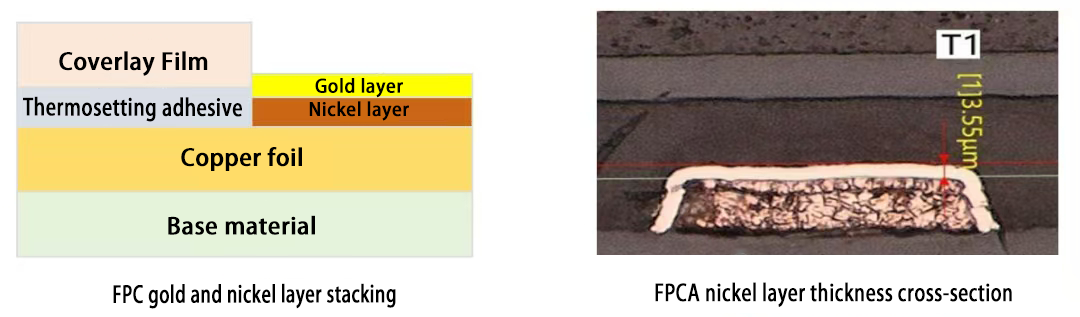
The surface of the FPC copper layer features gold and nickel layers. These metals are typically deposited onto the copper surface via Electroless Nickel Immersion Gold (ENIG) or Electroplated Nickel Gold processes to enhance the overall performance of the FPC. Among FPC surface treatment technologies, the ENIG process is currently the mainstream method.
Why is the process sequence on the FPC copper surface designed to deposit nickel before gold? The primary reasons are as follows:
①To prevent interdiffusion between the gold and copper layers.Gold and copper are two metals that readily diffuse into each other. Under ambient or high-temperature conditions, copper atoms can rapidly migrate through the thin gold layer to the surface, where they quickly form copper oxide. This leads to a sharp decline in FPC surface solderability, an increase in contact resistance, and potential defects in soldering, bonding, or electrical continuity.
The introduction of a nickel metal layer creates an effective "diffusion barrier" between the gold and copper, preventing these failures from occurring.
②To enhance resistance to oxidation and corrosion.
Nickel and copper are prone to oxidation when exposed to air for extended periods. In contrast, gold is an inert metal that hardly oxidizes in the atmosphere. This effectively ensures the cleanliness of the FPC bonding fingers or pad surfaces, improves bonding and solderability performance, and simultaneously reduces the risk of FPC oxidation and corrosion.
③To provide a hard supporting surface and enhance mechanical strength.
Pure copper and pure gold are relatively soft materials. During repeated mating cycles of the FPC or contact with connector terminals, they are susceptible to wear and abrasion. However, since nickel has a higher hardness than copper and offers superior wear resistance, it effectively protects the underlying copper layer.
The thickness of the gold and nickel layers in an FPC directly impacts its resistance to corrosion and oxidation. Specifically, the thickness determines the FPC's performance in salt spray testing; different salt spray standards require different gold and nickel thicknesses. Naturally, increasing the thickness of these layers will result in higher FPC manufacturing costs.
3.Control Requirements for the Width and Thickness of FPC Bonding Gold Fingers
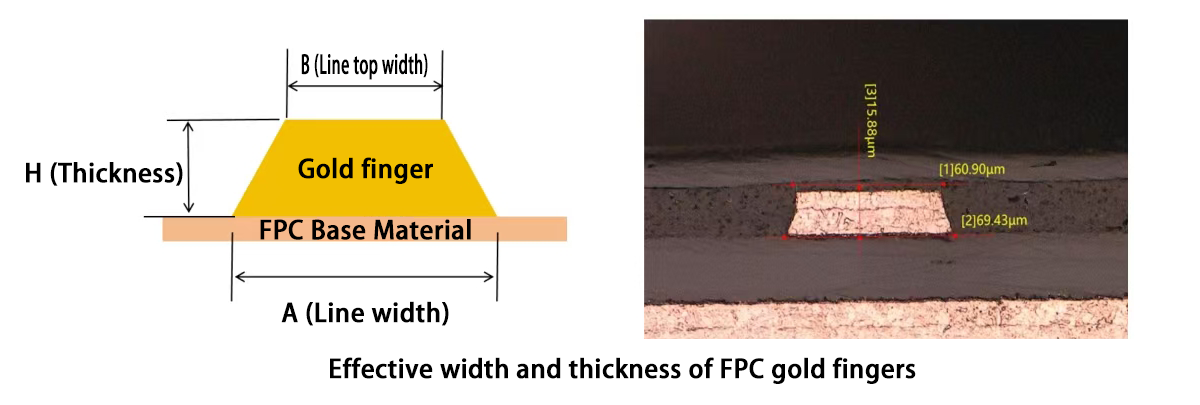
The width and thickness of FPC bonding gold fingers are critical technical specifications within the FPC design, as they directly determine whether the FOG bonding quality meets the required standards.
①Width of FPC Gold Fingers:The width of the FPC gold fingers directly affects the effective contact area between the FPC bonding pads and the LCD bonding pads, which ultimately influences the number of effective conductive gold balls per pad. If the actual effective width of the FPC bonding fingers is too narrow, a higher density of conductive particles in the ACF (Anisotropic Conductive Film) would be required to meet the minimum gold ball count per pad. This, in turn, increases the selection cost of the FOG ACF.
Note: There is a distinction between "top line width" and "bottom line width." Typically, the "effective width" of an FPC gold finger refers to the "top line width."
In summary, the effective width of FPC gold fingers is generally required to target the mid-to-upper limit. Therefore, when defining the tolerance specifications for the FPC bonding finger width, it is recommended to control it based on the minimum value.
②Thickness of FPC Gold Fingers:
The thickness of FPC gold fingers impacts the FOG bonding quality, specifically affecting the deformation (indentation) of the conductive gold particles.
When the thickness of the FOG ACF is constant, if the FPC gold finger thickness is excessive, the actual compressive force applied to the conductive particles within the ACF will be reduced under the same bonding pressure and head stroke. This results in the gold particles failing to deform sufficiently, leading to the issue of shallow particle indentation.
Regarding the selection and matching of FPC gold finger thickness and FOG ACF thickness, the following control requirements are generally established:
●The Pitch value of the FPC gold fingers is around 0.11~0.12mm. It is recommended to control the thickness of the FPC gold fingers (including the gold and nickel layer thickness) within the range of 13~14𝓊𝑚, with a specific focus on whether the gold finger thickness exceeds the upper limit.
●In current TFT-LCD display modules, the mainstream solution utilizes a 12𝓊𝑚 FPC base copper thickness paired with a 25𝓊𝑚 FOG ACF thickness. While 20𝓊𝑚 FOG ACF is also an option, special attention must be paid to the risk of bonding bubbles caused by insufficient filling of the FPC gold fingers.
4.Control Requirements for the Dyne Value of FPC Gold FingersThe Dyne value of the FPC gold finger surface is a critical yet often overlooked control requirement in FPC manufacturing. If the Dyne value fails to meet the specifications, it typically leads to issues such as "insufficient FPC peel strength," "shallow conductive gold ball indentation," and "failures during reliability testing" after FOG bonding.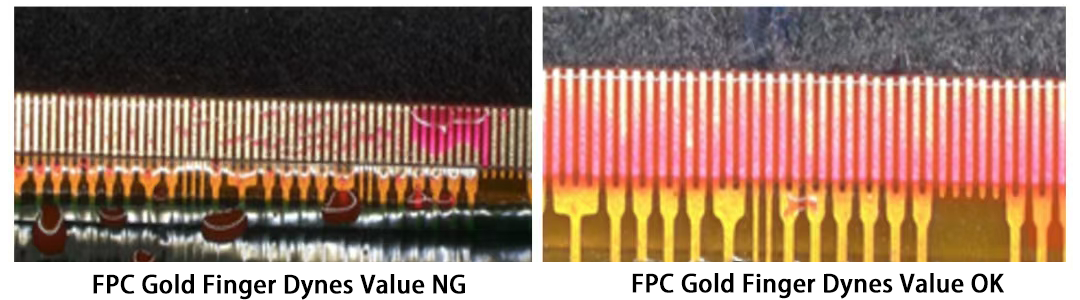
To ensure the Dyne value of the FPC gold finger surface, the current mainstream industry practice is to subject the FPC gold finger area to 100% Plasma treatment. Simultaneously, the Dyne value is strictly controlled, with a general recommendation that it should be ≥32.
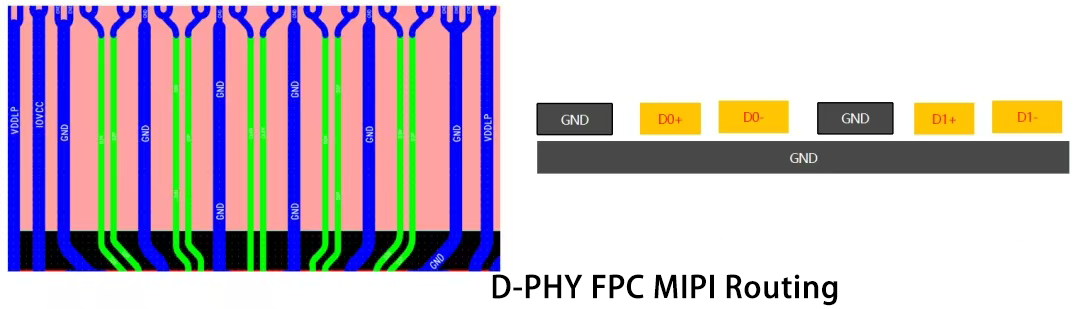
5.FPC MIPI Line Impedance Matching RequirementsAs the demand for higher resolution and refresh rates in LCDs increases, the MIPI interface has become the standard for LCDs in consumer electronics. Consequently, the FPCs used in MIPI-based LCD modules require precise impedance matching on the MIPI traces to ensure data transmission integrity and guarantee the normal display performance of the LCD module.
In the physical layer standards of MIPI, C-PHY and D-PHY are the two most common types applied in LCD display products. Different physical layer standards entail different impedance requirements for the corresponding FPC MIPI traces.
In summary: Physical traces for both D-PHY and C-PHY interfaces require impedance matching.
●D-PHY Interface: The physical traces require a differential impedance of 100±10% Ω.
●C-PHY Interface: The physical traces require a single-ended impedance of 50±5% Ω.
These impedance control standards generally need to be clearly identified in the FPC design drawings.